
When the sun sets over Kuta or Seminyak, the island of Bali transforms into a paradise of neon lights, acoustic music, and beachside cocktails. But if you drive an hour north, deep into the rice terraces of Gianyar or the quiet villages of Karangasem, the night feels different.
The darkness here is thick and heavy. The air smells of fading frangipani and the cloying sweetness of burnt incense.
Here, when the village dogs begin to howl in unison, the locals don’t check for intruders. They check their windows. They whisper prayers.
They know that the “Island of the Gods” casts a long shadow, and lurking within that shadow is the Leak.
To the uninitiated Westerner, the Leak (often spelled Leyak) sounds like a ghost story invented to frighten children. But ask a Balinese elder, and the smile will fade from their face.
The Leak is not a ghost. It is not a demon from hell. It is something far more unsettling: it is your neighbor.
In Balinese folklore, a Leak is a human being—a practitioner of ancient dark arts known as Ilmu Pengeleakan. By day, they are ordinary villagers.
They farm the rice fields, attend ceremonies, and smile at tourists. But by night, through intense meditation and the chanting of secret mantras, they detach their spirit from their physical body.
The manifestation of this spirit is the stuff of nightmares. In its most potent form, the Leak appears as a floating, severed head. Beneath the neck, there is no body—only a gore-slicked trailing of internal organs: the heart, the liver, and the intestines, glowing with a sickly, pulsating light.
They soar over the rooftops, hunting for the vital essence of life—often found in the blood of newborn infants or the decay of fresh corpses in the Setra (graveyard).
Where did this dark magic begin? The roots of the Leak are twisted around the legendary figure of Calon Arang.
History tells us that in the 11th century, during the reign of King Airlangga, there lived a widow named Calon Arang.
She possessed immense mystical power, but her heart was consumed by rage. When her beautiful daughter, Ratna Manggali, could not find a suitor because the villagers feared her mother’s sorcery, Calon Arang snapped.
She did not just curse the village; she decimated it. She offered a sacrifice to the dark goddess Durga and unleashed a plague that rotted people from the inside out.
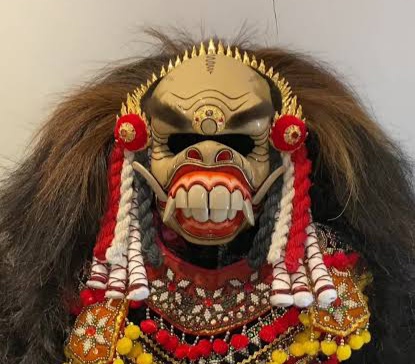
This narrative is re-enacted annually in the sacred Barong and Rangda dance. When you see the terrifying mask of Rangda—with her bulging eyes, boar-like fangs, and meter-long tongue—you are looking at the Queen of the Leaks. She is the patron saint of dark magic, the mother of all who practice the left-hand path.
The terror of the Leak lies in its ambiguity. You rarely see the flying head. Instead, the magic of Pengeleakan is the magic of transformation.
Ancient palm-leaf manuscripts, known as Lontar, describe a hierarchy of shape-shifting. A novice practitioner might only be able to transform into a simple light—a fireball (called Ndaru) that dances over the rice fields.
Others transform into animals: a monkey with human eyes, a pig that walks with a strange gait, or a black dog that disappears into thin air.
This belief is so potent that in rural Bali, if a villager injures a suspicious animal at night—slashing the leg of a strange dog, for instance—they wait for morning.
If a neighbor emerges the next day with a fresh, unexplained wound on their leg, the community knows. The veil has been lifted. The sorcerer has been marked.
Why do the Balinese, the most devout and ritualistic people in Indonesia, allow such darkness to exist?
The answer lies in the philosophy of Rwa Bhineda—the two opposites. In the Balinese worldview, good (Dharma) cannot exist without evil (Adharma). Light has no meaning without the dark.
The magic of the Leak is not inherently “evil” in its origin; it is simply power. It is the “Left-Hand Path.” In theory, one studies it to understand the full spectrum of the universe. It becomes evil only when the practitioner succumbs to greed, jealousy, or the desire for immortality, using the power to inflict sickness or death upon others.
To combat this, the Balinese rely on the Balian (traditional healer). If a doctor cannot cure a sudden illness, it is assumed to be “medical scale” (non-medical/magical). The Balian acts as a spiritual detective, engaging in a psychic battle with the Leak to return the curse to its sender.
Today, as Instagram influencers pose in front of temple gates, the ancient fires of the Leak still burn. You can see it in the Poleng cloth (black and white checkered fabric) wrapped around the great Banyan trees—symbols of protection against unseen forces. You can see it in the Canang Sari offerings placed carefully at crossroads, intended to appease the lower spirits.
The Leak serves as a reminder that Bali is not a theme park. It is a living, breathing complex of spiritual energies. It is a place where the barrier between the seen (Sekala) and the unseen (Niskala) is incredibly thin.
So, the next time you find yourself in Bali, enjoying the silence of the night, listen closely. If you hear the wind rustling through the palm fronds, it is likely just the wind. But if you see a lonely light bobbing in the distance, hovering just above the tree line… don’t stare too long.
Some things in Bali are not meant to be seen. (BT)